 RipCompass
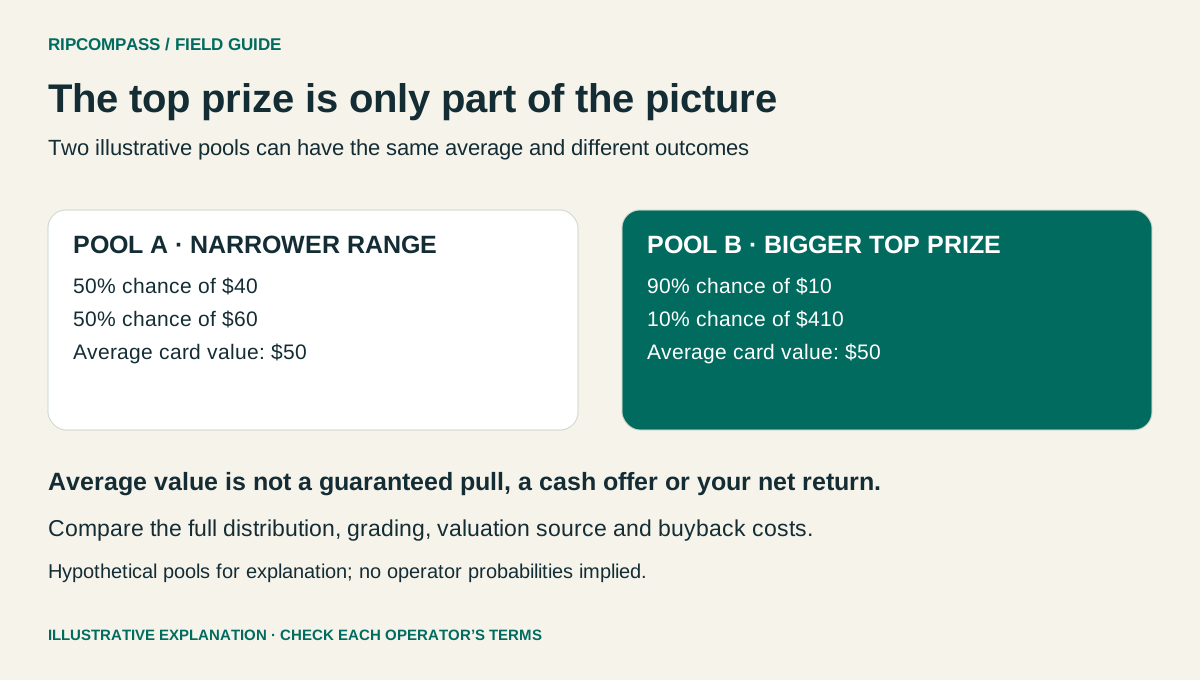
A chase card is not a typical result
A valuable card shown on a pack’s cover tells you little without the probability of receiving it and the other possible outcomes. Read the entire distribution, including lower-value tiers. A recent-pulls feed is a selected view of activity, not a complete dataset for estimating returns.
Check whether the displayed odds refer to an individual card, a rarity band or a value band. Those are not interchangeable. A 10% chance of a tier does not mean a 10% chance of the most expensive item pictured in that tier.
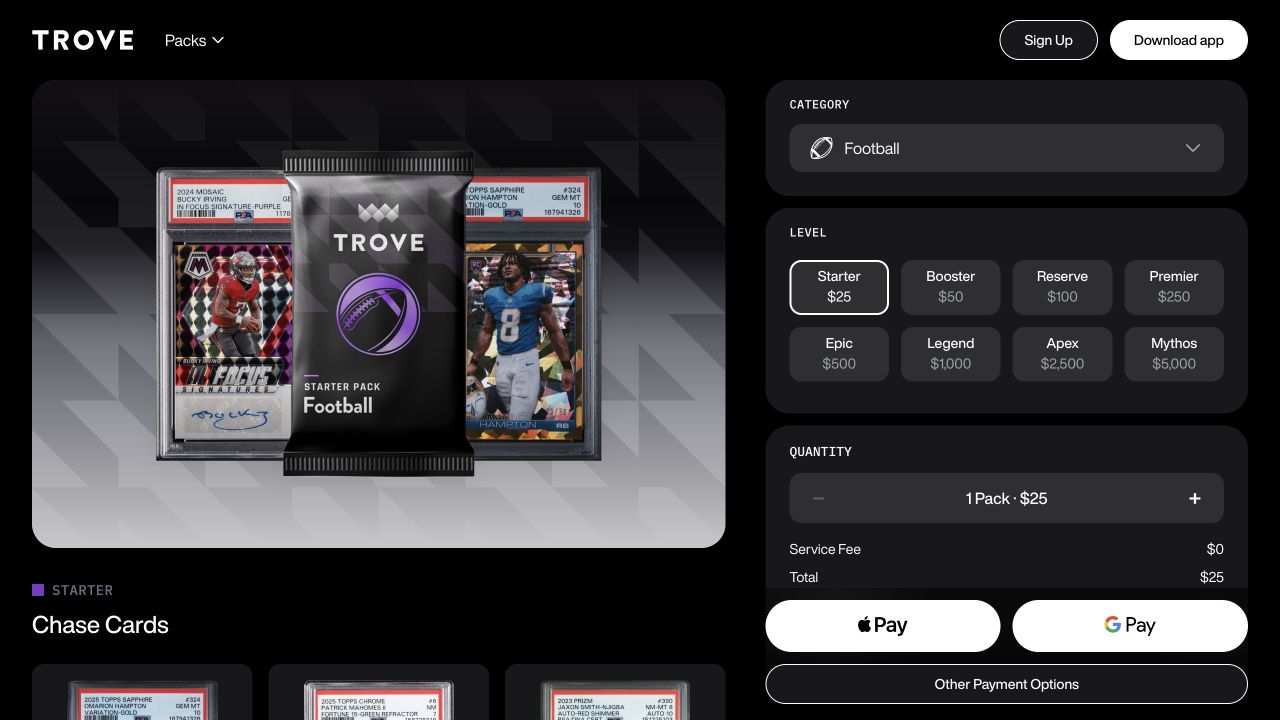
Trove’s Football Starter page places the selected $25 tier alongside a chase-card section. A pictured chase is a possible highlight; inspect the pack’s probability details to understand how it relates to the full pool.
Screenshot captured September 14, 2026. View official source ↗ · Select the image to enlarge.
Expected value needs credible inputs
In a fully specified hypothetical pool, multiply each outcome’s value by its probability and add the results. That gives a probability-weighted average for those inputs, not a guarantee for one purchase. If you are evaluating immediate sell-back, use the actual sell-back proceeds rather than a larger headline card valuation.
For example, a hypothetical 90% chance of $20 proceeds and 10% chance of $200 proceeds averages $38. A $50 purchase would have a negative $12 average difference before other costs under that exact model. A single opening can still differ substantially. The example is invented to explain the arithmetic.
What makes a useful card-value comparison
Match the card, release, language, variant, grading company and grade. Prefer completed sales with dates and enough context to identify what changed hands. Remove comparisons for different editions and be cautious when only a few transactions exist.
A displayed valuation can become stale as the market moves. Even a recent sale does not guarantee another buyer will pay the same amount. Record the date of your comparison and distinguish an estimated market value from an offer someone will execute now.
Provably fair is a narrower claim
A verification method may help establish that a result was not altered after a commitment. It does not on its own establish that the card valuation is accurate, that the price is attractive, that a vault contains every stated card or that shipping will succeed.
Read what the specific verification process covers and what data you need to reproduce it. Separate a technical randomness claim from custody, pricing and fulfillment claims. Each needs its own evidence.
When information is missing
If probabilities, pool details or the valuation basis are missing, you cannot responsibly fill in a return estimate from a handful of visible wins. Treat the uncertainty as part of the decision. It is reasonable to choose a transparent direct-card purchase when the missing information matters to you.
About this guide
Educational explanations and illustrative calculations from RipCompass team. Examples are not observed pack results. Operator-specific terms are linked in our reviews.
Published September 14, 2026. Suggest a correction.
Put the details side by side
Explore the card ripping site comparison or read our pre-purchase checklist.