 RipCompass
A dated field note. This article uses information checked September 19, 2026. It does not confirm today’s stock, prices or highest available pull. Our disclosure.
| Platform | Observed example | What the headline means | Delivery consideration |
|---|---|---|---|
| LastPack | $5 Starter, Steady mode | 95% displayed EV includes about 90% pack value plus 5% rewards | Up to 5 business days to dispatch, then carrier transit |
| MNSTR | $50 Pokémon Starter | 86% selected-pack buyback; $54.75 displayed average card value | $20 US / $40 international shipping plus $5 per card and applicable tax |
| OpenThatPack | $11 Pokémon 30th Celebration listing | Rarity/slot odds; not a cash-return percentage | UPS Express 1–3 business days in transit after dispatch |
Which platform is the best fit?
LastPack offers a low-price entry point in the observed $5 Starter. MNSTR is more relevant if you want to inspect a graded-card pool and are comfortable with wallet-based ownership. OpenThatPack presents a set-oriented opening experience with published rarity odds. None of those differences establishes a universal winner: first decide whether your goal is a particular physical card, a random reveal or selling back the result.
The comparison below uses September 19 snapshots. It focuses on the purchase decision rather than ranking three percentages that measure different things. A pack’s average card value, its buyback rate and its chance of a rare card cannot be substituted for each other.
LastPack: a $5 Starter and a rewards-inclusive headline
The LastPack Starter in Steady mode displayed a $5 price, a $3.50 minimum and a $625 maximum. Its published bands put 70% of outcomes between $3.50 and $5, 22% between $5 and $7.50, 6% between $7.50 and $15, 1.9% between $15 and $40 and 0.1% between $40 and $625. These are value ranges, not promises that a particular opening lands at a range’s upper end.
The expected-value panel displayed 95%, broken into approximately 90% pack value and 5% rewards. On a $5 opening, the headline corresponds to $4.75 including the rewards component; the pack-value component is about $4.50. Do not describe the full $4.75 as a guaranteed card value or immediately withdrawable money.
LastPack advertises sellback at 100% of its fair-market valuation. That still does not mean recovering 100% of the pack price. Its FAQ also describes a seven-day holding period followed by automatic sellback. If you want the card shipped, make the delivery decision within the applicable window.
MNSTR: why $54.75 average value is not $54.75 cash
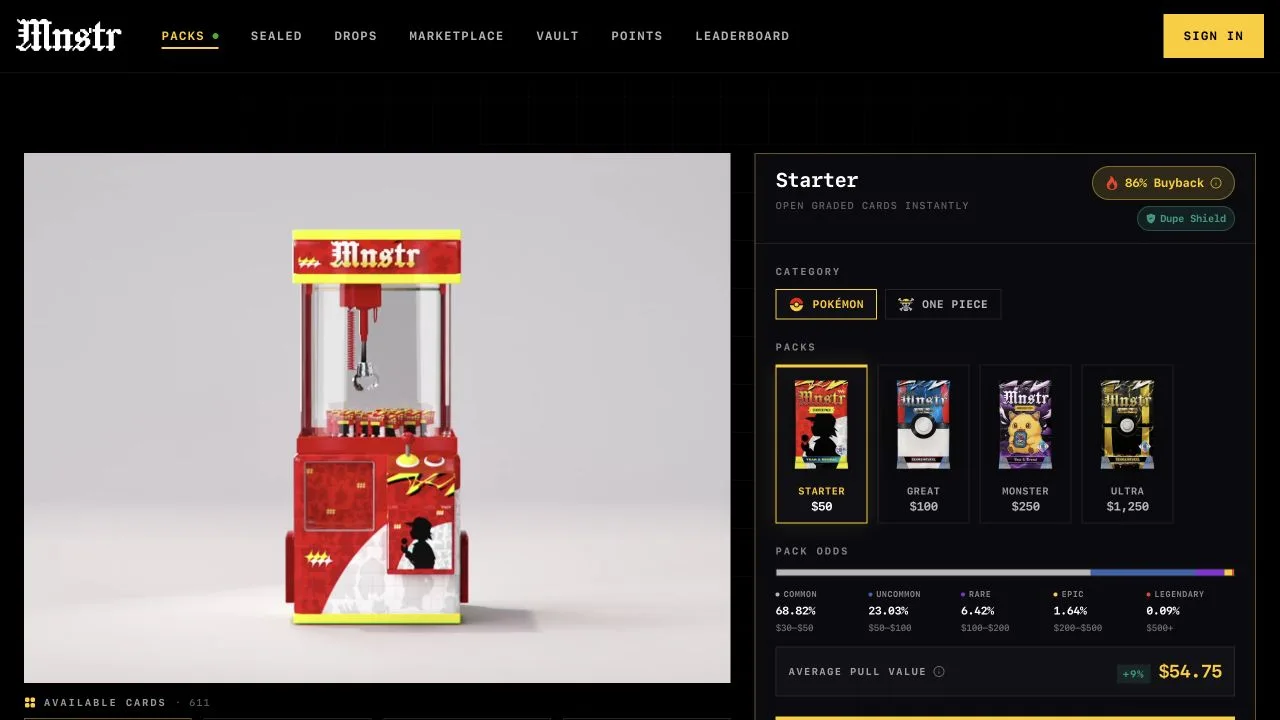
MNSTR’s $50 Pokémon Starter displayed an average card value of $54.75 and a pack-specific 86% buyback. The gross average divided by price is 109.5%. Applying the displayed buyback instead gives $54.75 × 0.86 = $47.085, approximately $47.09 before other costs. That is 94.17% of the $50 purchase price.
This calculation combines the page’s displayed statistics; it is not an independently audited expected payout. Averages can be lifted by very rare expensive cards. The largest published Starter band was 68.82% between $30 and $50, while the $500-plus band was only 0.09%.
The homepage’s “up to 95%” buyback headline should not replace the selected Starter’s 86% in your calculation. Also establish the form of proceeds: MNSTR’s terms describe wallet-based flows that may use USDm on MegaETH. A dollar-denominated balance is not automatically a bank withdrawal.
OpenThatPack: set odds need a different comparison
The observed Pokémon 30th Celebration listing cost $11. Its odds panel displayed categories including Double Rare at 1 in 4, Illustration Rare at 1 in 6, Special Illustration Rare at 1 in 19 and RGB at 1 in 10,000. These are the platform’s displayed categories and odds for its offering; they should not be generalized to every sealed Pokémon retail pack.
Rarity or slot probabilities can overlap. Adding them together as though they were mutually exclusive card-value buckets would create a misleading distribution. They also do not tell you the average dollar value of an opening without complete outcome values and their probabilities.
OpenThatPack’s terms distinguish promotional credits from withdrawable funds, and a buyback quote need not equal an external market valuation. Inspect the executable offer and its redemption restrictions. No directly comparable expected cash-return percentage is established by the rarity panel alone.
Shipping can change which option makes sense
LastPack’s FAQ allows up to five business days to dispatch, before carrier transit. Its account requirements include a US phone number; the existence of international carriers does not establish universal purchase eligibility. Confirm both account access and the delivery destination.
MNSTR lists $20 US or $40 international shipping, plus $5 handling per card and applicable sales tax. For one card, the stated starting cost is therefore $25 domestic or $45 international before taxes. A lower-value pull can be expensive to redeem relative to buying the same single elsewhere.
OpenThatPack advertises UPS Express transit of one to three business days after dispatch. That is not a one-to-three-day guarantee from the moment you open a pack. Its shipping page and broad terms also need to be read alongside the actual checkout quote for duties and charges.
For all three, an opening and a shipping request are separate steps. Check the dispatch estimate, tracking, insurance, address restrictions and whether keeping inventory triggers a deadline.
A practical way to choose before depositing
Start with your budget and preferred outcome. For a low-cost random opening, inspect the LastPack Starter’s current pool and rewards rules. For a graded-card inventory with explicit per-card probabilities, compare MNSTR’s actual buyback and delivery bill. For set-based openings, examine OpenThatPack’s specific product description and rarity panel.
Then compare a known single. If you mainly want one particular card, a mystery opening introduces uncertainty that a direct purchase avoids. Match language, card number, grade and condition before comparing prices.
Finally, run two separate calculations: what you receive after a sellback and withdrawal, and what it costs to get the card delivered. Neither needs an invented universal return rate. Use the full reviews for eligibility and product details, and recheck the offer immediately before purchase.
Frequently asked questions
Does LastPack’s 95% expected value mean a 95% cash refund?
No. The observed Starter panel included approximately 90% pack value plus 5% rewards. Rewards, card valuations and withdrawable proceeds have different rules.
Does every MNSTR pack offer 95% buyback?
No. The homepage advertises up to 95%, but the Starter snapshot used here displayed 86%. Use the current offer for the selected pack and account.
Can OpenThatPack rarity odds be compared directly with MNSTR’s average value?
No. Rarity probabilities do not establish expected dollar value without the full outcome distribution and valuations. They can also describe overlapping slots or categories.
Which platform ships fastest?
The published figures are not directly comparable. LastPack describes processing before dispatch, OpenThatPack describes express transit after dispatch, and MNSTR requires a destination-specific estimate. Compare the complete processing-plus-transit quote.
Sources and research scope
This comparison uses the cited public sources, dated research and explicitly labeled illustrative calculations. Historical screenshots retain their capture dates. No purchase, withdrawal or shipment was performed.
Read our LastPack review, compare mystery-pack sites, explore collectible mystery boxes or suggest a correction.