 RipCompass
A dated field note. This article uses information checked September 22, 2026. Grading fees, service availability and turnaround estimates can change. Shipping time is separate; confirm your submission quote before sending cards. Our disclosure.
Where is the best place to grade cards?
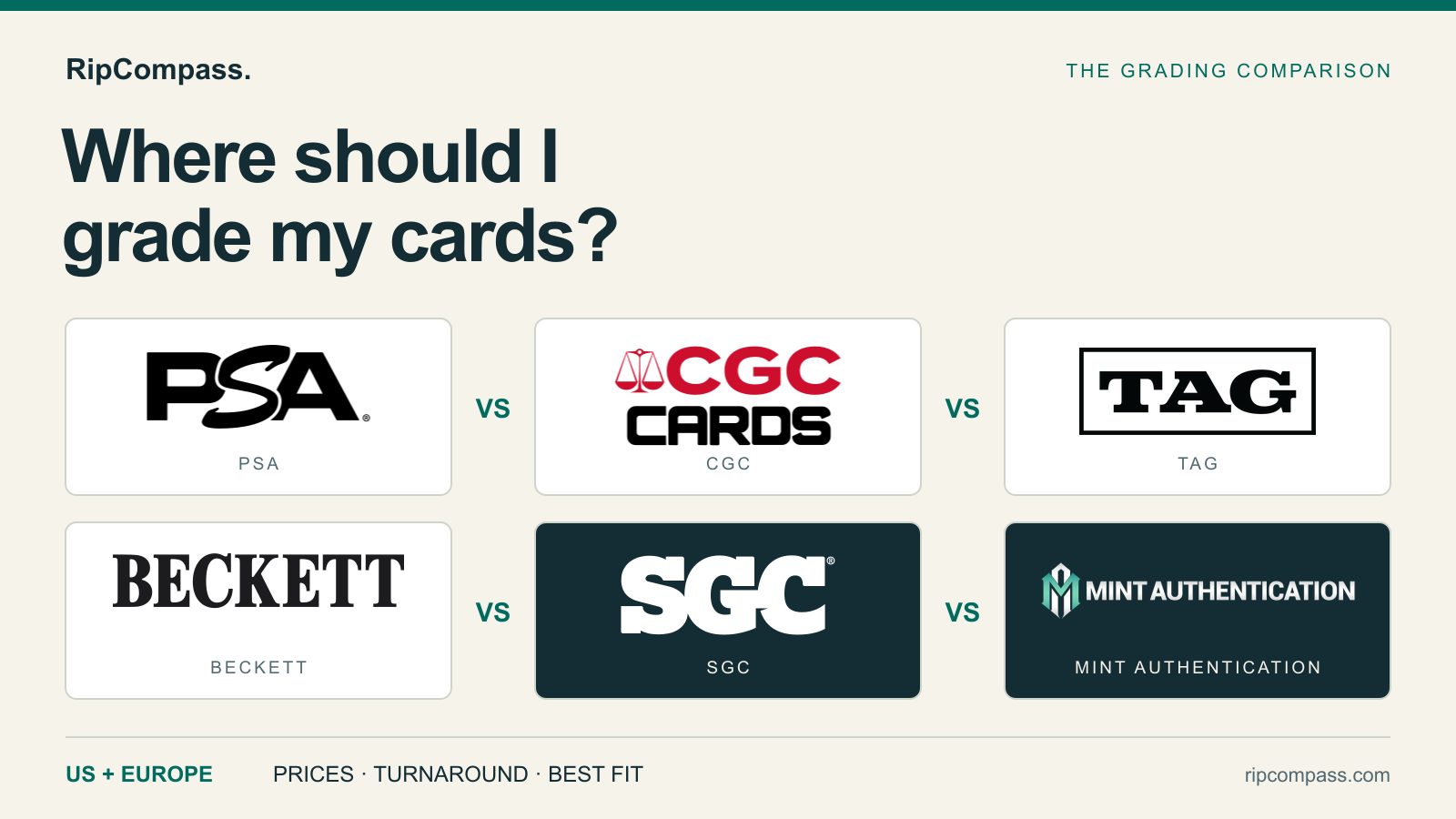
Start with the card and your reason for grading. Our shortlist is PSA for collectors building a PSA collection or comparing PSA auction records; CGC for a relatively inexpensive single-card submission; TAG for a detailed digital grading report; Beckett for collectors who want subgrades; SGC for collectors who prefer its holder and service options; and Mint Authentication for a lower-fee alternative.
There is no single best card grading company for every card. A cheap slab can be a good personal-collection purchase without being the strongest resale choice. Before paying, compare completed sales for the exact card, language, variation and grade you realistically expect. Do not assume a 10 from one grader has the same market value as another company’s 10.
The tables below cover direct US submissions and separately available European routes. In this guide, MINT means Mint Authentication at mintauthentication.com; it is distinct from Mint Grading, Mint Grading Company and Canada’s MNT Grading.
US card grading prices and turnaround times
These are selected tiers, not every available service. Fees are per card in USD before shipping, insurance, applicable tax, membership costs and optional services. A value ceiling can require a more expensive tier. Business days exclude weekends and holidays; the quoted grading period is not your door-to-door delivery time.
Availability alert: TAG’s Basic, Standard and Express tiers are paused. Their reference prices are retained below for context, not as currently bookable offers; limited drops and Priority availability must be checked separately.
| Grader / tier | Price per card | Grading estimate | Minimum / value or coverage |
|---|---|---|---|
| PSA Standard | $59.99 | 90–100 days | $1,000 maximum insured value |
| PSA Priority | $79.99 | 70–80 days | $1,500 maximum insured value |
| CGC Economy | $20 | 90 days | $1,000 maximum card value |
| CGC Bulk | $17 | 150 days | 25 cards; $500 maximum card value |
| CGC Standard | $55 | 10 days | $3,000 maximum card value |
| TAG Basic — paused | $22 | 45+ days (reference only) | 10 cards; $300/card standard coverage |
| TAG Standard — paused | $39 | 30 days (reference only) | $500/card standard coverage |
| TAG Express — paused | $59 | 15 days (reference only) | $1,000/card standard coverage |
| TAG Priority — limited | $149 | 5 days published; confirm live quote | $2,500/card standard coverage; capacity limited |
| Beckett Base | $17.95 | 75+ days | Temporary US form; subgrades included |
| Beckett Standard | $34.95 | 45 days | Temporary US form |
| Beckett Express | $79.95 | 15 days | Temporary US form |
| SGC Standard | $50 | 40+ days | $1,500 maximum declared value |
| SGC Expedited | $150 | 2–3 days | $3,500 maximum declared value |
| Mint Authentication Standard | $14 | 15–20 days | 1–25 cards; shipping / insurance extra |
| Mint Authentication Express | $34 | 2–5 days | 1–25 cards; shipping / insurance extra |
Card grading in Europe: euro prices and available routes
European availability is not the same as a US price converted into euros. Use the submission route that accepts your country, and check whether grading happens locally or the company forwards your cards abroad. The UK is shown separately in pounds. A UK partner is not automatically an EU-wide service.
| Service / route | Published fee per card | Grading estimate | Route / restriction |
|---|---|---|---|
| PSA Europe Standard | €49.99 introductory | 80–90 business days | €900 maximum insured value; listed regular price €59.99 |
| PSA Europe Priority | €69.99 introductory | 70–80 business days | €1,300 maximum insured value; listed regular price €79.99 |
| CGC Munich Bulk | €20.23 incl. VAT | 75 working days | 25-card minimum; €500 maximum value |
| CGC Munich Economy | €22.61 incl. VAT | 45 working days | €1,000 maximum value |
| TAG via The Sub Center (UK), X | £21 | 30 business days advertised | Partner listing; reconfirm intake during TAG pause; batching / transit extra |
| Beckett Europe | New online quote unavailable | Not currently bookable online | EU online submissions temporarily unavailable |
| SGC from Europe | US fee + international quote | US grading estimate + transit | No verified local euro-priced route in this comparison |
| Mint Authentication from Europe | Request written international quote | Not verified door-to-door | No verified EU price or submission route in this comparison |
1. PSA: best fit for a PSA collection and price research
Choose PSA when the PSA label itself matters to your collection or your target buyers. Its auction-price resources and registry provide a starting point for research. That does not establish a guaranteed resale premium for your particular card.
The trade-off is cost and patience: the live US table currently starts at Standard, while Value and Value Bulk are paused. European introductory pricing is a separate offer. Use the live regional schedule rather than an older price announcement, and check both the insured-value limit and which countries the route accepts.
2. CGC: best fit for a lower-cost single-card submission
Our budget shortlist for an individual card starts with CGC Economy among the larger services compared here. Bulk costs less per card but has a minimum quantity and a much longer US estimate. Standard buys a shorter US grading estimate at a higher fee. Membership discounts can change the total, so include membership cost when comparing a small order.
For Europe, CGC’s current Munich fee table says TCGs are graded in Germany, while sports and mixed submissions go to the US. The same page retains older general forwarding language: confirm the route for your exact submission. Its higher European tiers do not automatically carry the much shorter US estimates.
3. TAG: best fit for understanding the grade
TAG is our shortlist choice when you want the reasoning behind a grade in a digital report. Its service description includes QR-accessible DIG reports and card imaging. Basic and the higher tiers differ in scoring features and coverage; buy the report level you actually want, not just the cheapest headline.
Current availability matters more than the old price list: TAG’s regular tiers are paused, with limited submissions released separately. Do not interpret a published $22 Basic rate as an available booking. Its eligibility page also excludes Yu-Gi-Oh! and pre-1989 cards; accepted Pokémon languages are restricted.
TAG’s direct customer route is limited to the US and Canada. Other regions must use an authorized affiliate submission partner. The UK partner example has a monthly cutoff on the 15th and estimates another seven working days to prepare the batch before transit. That waiting period sits outside the advertised grading turnaround. Ask for the current tier name, included report, insurance and return costs before sending.
4. Beckett: best fit when subgrades matter
Beckett belongs on the shortlist when you want subgrades rather than only an overall number. Current US submissions use a temporary form, and the listed Base, Standard and Express rates are shown above. Check shipping, insurance and any autograph or oversize charges in the final order total.
The immediate European limitation is availability: Beckett EU online submissions were unavailable when checked. Existing received orders continue processing. Do not mail a new EU order using old instructions or assume the temporary Texas form is an EU booking.
5. SGC: compare the holder, value ceiling and speed
SGC is worth comparing if you prefer its presentation or already collect cards in SGC holders. Its published standard-size schedule starts at $50 for cards within the $1,500 declared-value ceiling. The faster tier costs substantially more and has its own value bracket.
Its clock starts after unboxing and entry into the system. That makes a two-to-three-day grading estimate different from receiving your cards back three days after posting them. For a valuable sports card, compare recent SGC and alternative-grader sales of that exact issue before deciding whether a faster return justifies the fee.
6. MINT: a lower-fee option for a personal collection
Mint Authentication’s Standard option is $14 per card for 1–25 cards; Express is $34. These are attractive entry fees if your priority is preserving and displaying a card. Our recommendation is conditional: compare actual completed MINT sales before assuming its label will deliver the resale result of a different grader.
Return shipping and your selected insurance are additional. We could not verify a European price or accepted international route from the cited product pages, so European readers should obtain a written quote before shipping. This entry refers only to Mint Authentication, not another company using “Mint” in its name.
How long until my graded cards are delivered?
Plan the whole journey: outbound shipping + receipt and intake + any partner batching + grading + dispatch + return shipping. Cross-border orders may add customs handling. A grader’s estimate usually covers only part of that journey and may change as demand changes.
For planning, 15–20 business days is roughly three to four working weeks before extra logistics, while 90–100 business days is roughly 18–20 working weeks. These are simple calendar translations, not delivery promises. A firm end-to-end estimate needs your country, carrier, service tier and submission route.
If you need a card for a sale or event, ask when the clock begins, whether the estimate is guaranteed, and what happens if it slips. An express grading fee does not by itself buy express shipping.
If you plan to keep the slab in storage after grading, compare the vault before choosing the submission route. RipCompass’s new vault reviews separate custody charges, selling access and the eventual cost of getting your cards home.
What does card grading really cost?
Add grading, outbound postage, return postage, insurance, tax, membership, partner handling and any extras. Then divide order-level costs by the number of cards. Watch for a higher service tier when the declared or assessed value exceeds the selected bracket. For cross-border orders, confirm the paperwork and charges with your carrier or submission partner.
Illustrative example: ten cards at $20 each cost $200 to grade. If combined postage and insurance are $45, the order costs $245, or $24.50 per card, before tax and other fees. The $45 is an invented example, not a carrier or grader quote.
For resale, compare expected net graded proceeds with net raw proceeds and the full grading cost. If the numbers only work at a perfect grade, the decision is fragile. Buying an already graded example can be cheaper and more predictable than buying raw, paying fees and waiting.
Where should I grade Pokémon, Yu-Gi-Oh! and sports cards?
For Pokémon or Yu-Gi-Oh!, match the exact set, language, print variant and grade when checking sales. Confirm that your grader accepts that language, size and card type. For a binder favourite, the holder and total cost may matter more than the resale label. For a resale submission, use conservative grade scenarios rather than assuming pack-fresh means perfect.
Sports cards need the same discipline, plus checks for serial numbers, autograph services, memorabilia thickness and unusual sizes. A standard trading-card fee may not cover every format. For older cards, confirm eligibility before choosing a service built around modern-card formats.
If you pulled an already graded card on a ripping platform, first verify its certification and condition. You may only need physical redemption, not a new grading submission. Check the platform’s actual delivery and storage rules before paying to move the card between services.
How to submit cards for grading
First, identify each card accurately and inspect it under good light. Choose a grader and a value-appropriate tier. Confirm current availability, card eligibility and your return address before completing the official submission form.
Next, photograph both sides and keep an inventory. Follow that grader’s current packaging instructions; protective-material requirements vary. Use suitable tracking and insurance, retain the paperwork, and record when the grader acknowledges receipt.
Finally, compare the returned certification record with your card and inspect the package promptly. Keep the invoice and photographs. If something is wrong, contact the grader through its official support process with the submission number and evidence.
Logan Paul, PSA and CGC: checking the switch claims
Celebrity grading choices are also in the news. Our separate timeline examines what is documented about Logan Paul’s PSA and CGC activity, and why it does not yet establish an exclusive switch.
Frequently asked questions
Where should I get my cards graded?
Choose by card type, goal and location. Compare PSA for PSA collections and price research, CGC for lower-fee single-card tiers, TAG for digital grading reports, Beckett for subgrades, and SGC or Mint Authentication when their holders and terms fit your collection. Check current eligibility and the full delivered cost.
How much does it cost to grade a card in the US?
The selected US services in this September 22, 2026 comparison range from $14 for Mint Authentication Standard to more expensive expedited tiers. Prices differ by service, quantity and card value. Postage, insurance, tax and extras can materially increase the cost.
Where can I grade cards in Europe?
PSA has a European submission route and CGC accepts submissions through Munich. Check the card-specific grading location and your country’s eligibility. Beckett EU online submissions were temporarily unavailable at the research cutoff; TAG requires an authorized partner outside the US and Canada.
Is PSA, CGC or TAG better for Pokémon cards?
There is no universal winner. Check completed sales if resale is your goal, report detail if you want to understand the grade, and the full fee if the card is for your own collection. Different companies’ grades and resale prices are not interchangeable.
How long does card grading take, including delivery?
The advertised grading period is only one part of the journey. Add outbound transit, intake or partner batching, dispatch and return transit. Cross-border handling may add more time. Ask for a route-specific estimate rather than treating a business-day grading figure as a delivery date.
Is it worth grading a card worth $20?
For resale, a low-value card may not justify grading, shipping and selling costs unless realistic graded outcomes support the expense. For a personal keepsake, you may value protection and presentation instead. Compare the cost with buying an already graded copy.
Does grading guarantee my card is worth more?
No. The resulting grade, demand, selling fees and buyer preference all affect the result. A disappointing grade or weak market can leave you with less net value after costs. A grading fee buys an assessment and encapsulation under the company’s terms, not a promised profit.
Is MINT the same as MNT Grading?
No. This article’s MINT entry is Mint Authentication at mintauthentication.com. MNT Grading in Canada and other businesses using Mint in their names are separate companies. Confirm the exact website before booking or sending cards.
Sources and research scope
Official grader pricing, submission forms and regional policies were checked September 22, 2026. Recommendations are the RipCompass team’s assessment of those published terms, not a test of grading accuracy or resale performance. We did not submit cards for this comparison. Prices remain in their original currencies; no exchange-rate conversion is presented as a local quote.
- PSA US grading fees — checked September 22, 2026 ↗
- PSA Europe grading fees — checked September 22, 2026 ↗
- CGC US fees — checked September 22, 2026 ↗
- CGC Munich fees — checked September 22, 2026 ↗
- TAG service tiers — checked September 22, 2026 ↗
- TAG international submissions — checked September 22, 2026 ↗
- TAG eligibility — checked September 22, 2026 ↗
- The Sub Center UK TAG rates — checked September 22, 2026 ↗
- Beckett US service availability — checked September 22, 2026 ↗
- Beckett US form and prices — checked September 22, 2026 ↗
- Beckett EU status — checked September 22, 2026 ↗
- SGC service schedule — checked September 22, 2026 ↗
- Mint Authentication Standard — checked September 22, 2026 ↗
- Mint Authentication Express — checked September 22, 2026 ↗
- Mint Authentication process — checked September 22, 2026 ↗
- PSA auction-price research — checked September 22, 2026 ↗
- TAG backlog and availability — checked September 22, 2026 ↗
compare mystery-pack sites, explore collectible mystery boxes or suggest a correction.